The Fixers’ Table: What UK Repair Cafés Are Teaching Coffee Lovers About Keeping Gear Alive
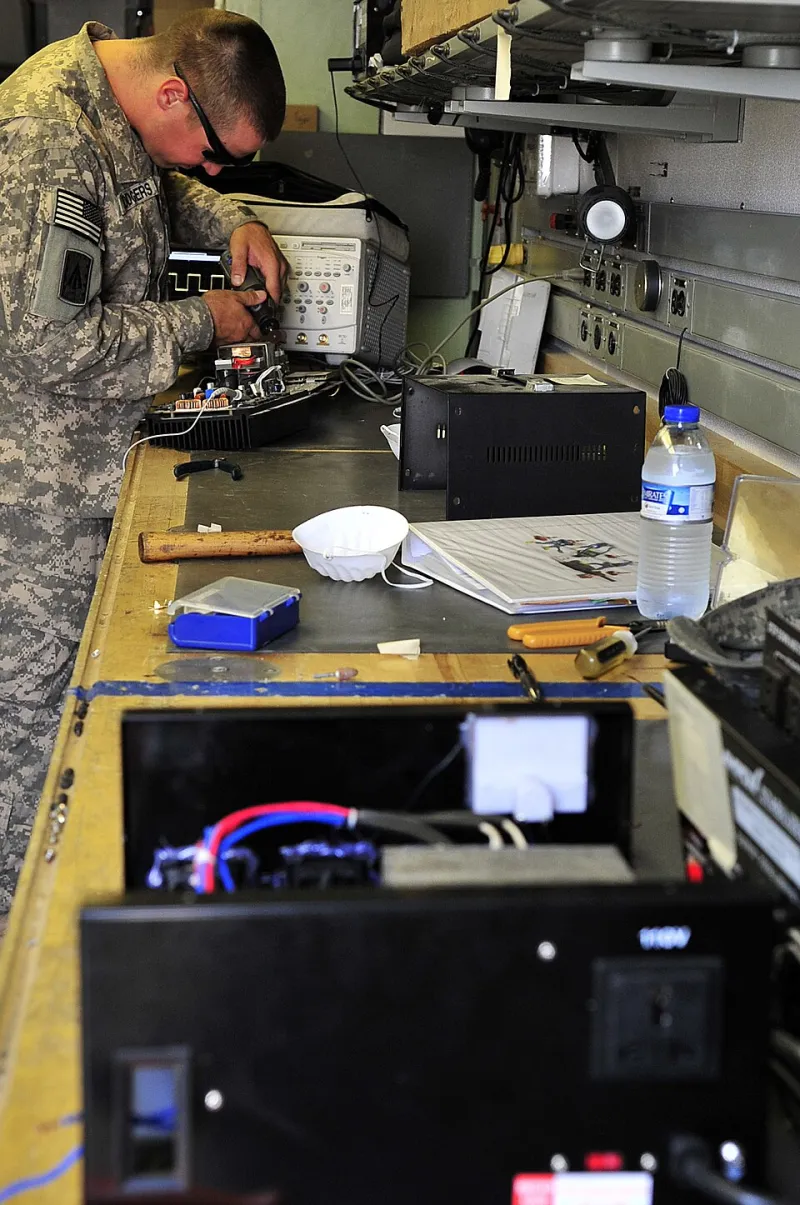
Photo: Tech. Sgt. Christina Styer, Public domain, via Wikimedia Commons
It is a Saturday morning in a church hall in Leeds, and the tables are already busy. A toaster waits next to a lamp, a vacuum cleaner sits on the floor, and in the corner a volunteer is peering into the hopper of a domestic grinder with a small torch. This is a repair café: part workshop, part social club, part quiet rebellion against the throwaway habit.
The coffee gear is easy to spot. There is a moka pot with a perished gasket, a Sage-style espresso machine with a sad note taped to it, and a hand grinder whose handle turns with a worrying crunch. None of them are antiques. They are the everyday kit of home baristas who would rather fix than replace — if they can find someone to show them how.
The coffee corner of the repair café
Repair cafés have spread across the UK over the past decade, often run by volunteers in community halls, libraries and sustainability hubs. The format is simple: bring a broken thing, sit with a fixer, and learn what is wrong. The mood is practical rather than preachy. Nobody minds if you do not know a torx screw from a tri-wing.
Coffee equipment has become a regular visitor. Grinders arrive clogged with oily residue, their burrs worn flat or their plastic gears stripped. Entry-level espresso machines come in with scaled boilers, failed pumps, split gaskets and steam wands blocked by hardened milk. Moka pots turn up with loose handles, worn threads and gaskets that have baked themselves into the lid.
What actually fails
At the bench, the pattern is clear. Grinders rarely die from one dramatic event. They die from neglect: old coffee oils clogging the chute, burrs that have never been replaced, and plastic drive parts that give way after years of grinding. Espresso machines often suffer from scale, especially in hard-water areas, or from simple wear items — gaskets, shower screens, thermostats and pumps. Moka pots are mostly a gasket-and-handle story, with the occasional stripped thread after years of over-tightening.
“Most of the grinders we see do not need a new motor,” says Ellen, a retired electrical engineer who volunteers at a repair café in Sheffield. “They need a clean, a new set of burrs, or a small plastic part that costs less than a takeaway coffee. The hard part is often finding the part and being willing to take the machine apart carefully.”
Raj, a roastery technician who helps at sessions in Manchester, sees the other side of the bench. “People bring in machines that have been used every day for five years and never descaled. We open them up and it looks like a geological sample. But a lot of it is recoverable if the electronics are still sound. The tricky ones are the machines with sealed boilers or no spare parts.”
Parts, patience and the right-to-repair mood
Since 2021, UK right-to-repair rules have required manufacturers to make spare parts available for certain appliances, but coffee gear sits in a confusing middle ground. Some brands are excellent, with exploded diagrams and reasonably priced wear parts. Others treat the internals as a secret. The result is that two machines of similar age can have very different fates.
The volunteers’ advice is to research before you buy. A model with a strong parts network — the Gaggia Classic is a common example, as are several popular Sage and Delonghi machines — is more likely to be fixable in five years’ time. Grinders with replaceable burrs and accessible chutes are similarly worth favouring. It is not about brand loyalty. It is about whether the thing can be kept alive.
Repair or replace: a home barista checklist
Before you bin a machine, ask yourself a few practical questions.
- What is the fault, and is it safe? If there is burning, exposed wiring or a leaking boiler, stop using it and get professional advice.
- What would the repair cost? If a genuine part plus labour comes to less than half the price of a comparable replacement, repair usually makes sense.
- Are parts available? Check the manual, the manufacturer’s spares site and independent parts shops. A cheap machine with no parts is not cheap in the long run.
- How old is it, and how hard has it worked? A well-built machine at five years old may have plenty of life left. A very cheap one with a cracked housing may not.
- Do you want to upgrade anyway? Be honest. Repair cafés are not there to guilt you into keeping something you have outgrown.
- Can you learn from it? Even if the fix is beyond you, a session can tell you whether it is worth paying a specialist.
How to use a repair café well
Bring the manual if you have it, along with any spare parts you have already bought. Clean the machine before you arrive — nobody wants to open a grinder full of month-old coffee. Describe the fault clearly: when it started, what it sounds like, whether it leaks, and what you have already tried. Be patient. The volunteer is not a free repair service; they are a guide. And if you can, stay and watch. The point is not just a working grinder. It is knowing how to keep it working.
As the Leeds session packs up, the moka pot leaves with a new gasket and a satisfied owner. The grinder is still on the bench, but it has been diagnosed, cleaned and given a parts list. It will be back. In a culture that makes replacing feel easy, that small act of repair feels quietly radical — and very much in the spirit of a better cup.